Inverse probability weighting (IPW), also known as propensity score weighting, is an alternative to matching that uses the propensity score to create a pseudo-population where treatment is independent of measured confounders (Rosenbaum 1987; Hirano, Imbens, and Ridder 2003).
Rather than discarding unmatched units, IPW reweights the sample so that treated and control groups have similar covariate distributions. This approach:
Fit a logistic regression (or more flexible model) to predict treatment:
# R exampleps_model <-glm(treatment ~ age + education + income + gender, data = df, family =binomial(link ="logit"))df$propensity <-predict(ps_model, type ="response")
library(tidyverse, quietly =TRUE)library(cobalt, quietly =TRUE)# Download the lalonde data data <- MatchIt::lalonde# Step 1: Estimate propensity scoresps_model <-glm(treat ~ age + educ + race + married + nodegree + re74 + re75,data = data,family =binomial(link ="logit"))data <- data %>%mutate(propensity =predict(ps_model, type ="response"))# Step 2: Calculate IPW weightsdata <- data %>%mutate(# ATE weightsweight_ate = treat / propensity + (1- treat) / (1- propensity),# ATT weights weight_att = treat + (1- treat) * propensity / (1- propensity),# Stabilized ATE weightsweight_ate_stab = (treat *mean(treat) / propensity) + ((1- treat) * (1-mean(treat)) / (1- propensity)) )# Step 3: Check balancebal.tab(treat ~ age + educ + race + married + nodegree + re74 + re75,data = data,weights ="weight_ate",stats =c("m", "v"),thresholds =c(m =0.1))
Note: `s.d.denom` not specified; assuming "pooled".
Balance Measures
               Type Diff.Adj        M.Threshold V.Ratio.Adj
age         Contin.  -0.1676 Not Balanced, >0.1      0.3689
educ        Contin.   0.1296 Not Balanced, >0.1      0.5657
race_black   Binary   0.0499     Balanced, <0.1           .
race_hispan  Binary   0.0047     Balanced, <0.1           .
race_white   Binary  -0.0546     Balanced, <0.1           .
married      Binary  -0.0944     Balanced, <0.1           .
nodegree     Binary  -0.0547     Balanced, <0.1           .
re74        Contin.  -0.2740 Not Balanced, >0.1      0.8208
re75        Contin.  -0.1579 Not Balanced, >0.1      0.9562

Balance tally for mean differences
                   count
Balanced, <0.1         5
Not Balanced, >0.1     4

Variable with the greatest mean difference
 Variable Diff.Adj        M.Threshold
     re74   -0.274 Not Balanced, >0.1

Effective sample sizes
           Control Treated
Unadjusted  429.    185.
Adjusted    329.01   58.33
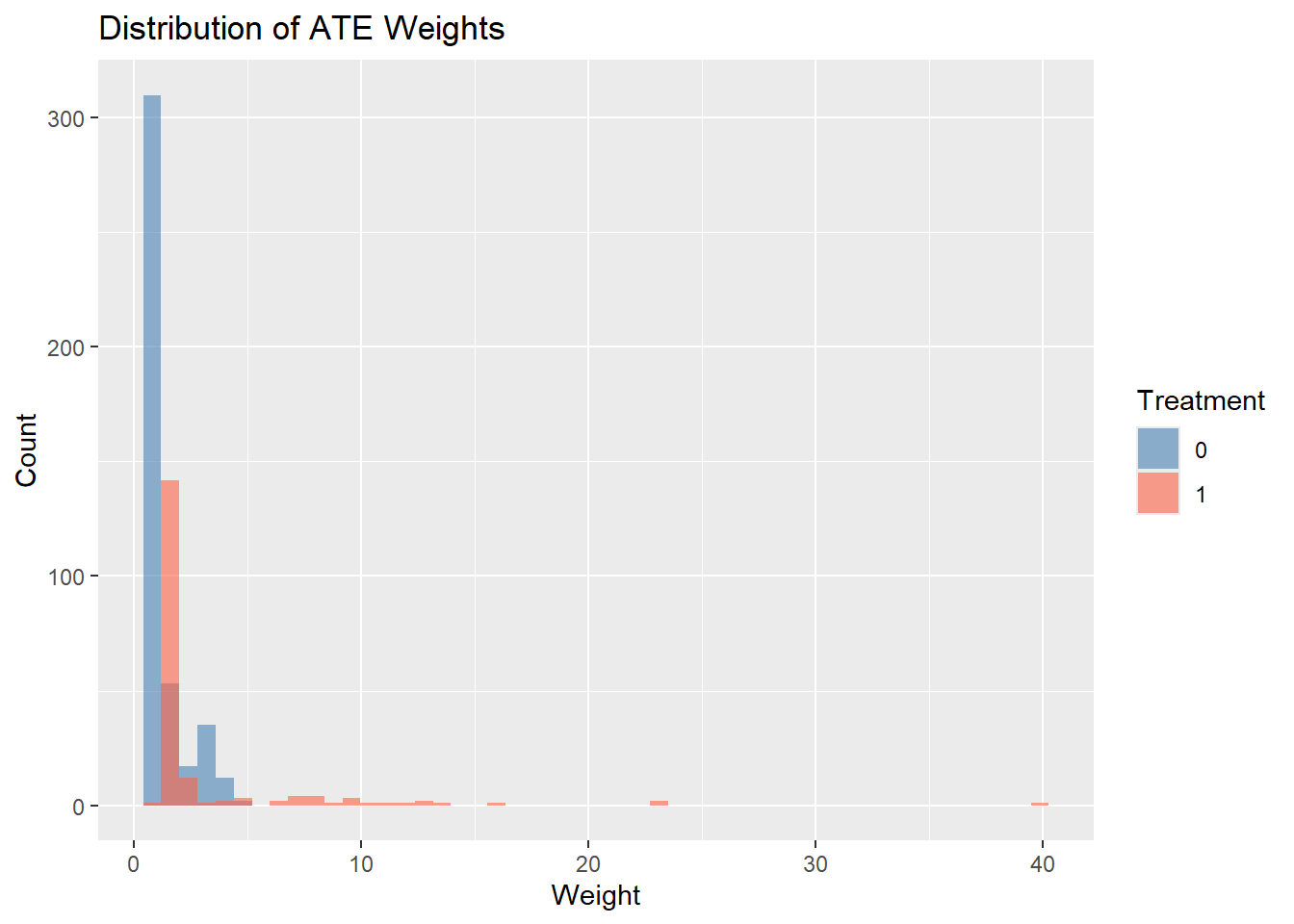
# Visualize weightsggplot(data, aes(x = weight_ate, group =as.factor(treat), fill =as.factor(treat))) +geom_histogram(bins =50, alpha =0.6, position ="identity") +labs(title ="Distribution of ATE Weights",x ="Weight", y ="Count",fill ="Treatment") +scale_fill_manual(values =c("0"="steelblue", "1"="tomato"))
# Step 4: Estimate treatment effectate_model <-lm(re78 ~ treat, data = data, weights = weight_ate)# Robust standard errorslibrary(sandwich, quietly =TRUE)library(lmtest, quietly =TRUE)coeftest(ate_model, vcov =vcovHC(ate_model, type ="HC3"))
t test of coefficients:

            Estimate Std. Error t value Pr(>|t|)
(Intercept)  6422.84     366.30 17.5344   <2e-16 ***
treat         224.68     939.66  0.2391   0.8111
---
Signif. codes:  0 '***' 0.001 '**' 0.01 '*' 0.05 '.' 0.1 ' ' 1
# Alternative: Use WeightIt packagelibrary(WeightIt, quietly =TRUE)W <-weightit(treat ~ age + educ + race + married + nodegree + re74 + re75,data = data,method ="ps",estimand ="ATE")summary(W)
                  Summary of weights

- Weight ranges:

          Min                                  Max
treated 1.172 |---------------------------| 40.077
control 1.009 |-|                            4.743

- Units with the 5 most extreme weights by group:

            137    124    116     68     10
 treated 13.545 15.988 23.297 23.389 40.077
            412    388    226    196    118
 control   4.03  4.059   4.24  4.523  4.743

- Weight statistics:

        Coef of Var   MAD Entropy # Zeros
treated       1.478 0.807   0.534       0
control       0.552 0.391   0.118       0

- Effective Sample Sizes:

           Control Treated
Unweighted  429.    185.
Weighted    329.01   58.33
Rosenbaum (1987) - Early development of propensity score methods
Hirano, Imbens, and Ridder (2003) - Efficient estimation with IPW
Robins, Hernan, and Brumback (2000) - Marginal structural models and stabilized weights
Li, Morgan, and Zaslavsky (2018) - Overlap weights for improved balance
Austin and Stuart (2015) - Comparison of propensity score methods
References
Austin, Peter C., and Elizabeth A. Stuart. 2015. “Moving Towards Best Practice When Using Inverse Probability of Treatment Weighting (IPTW) Using the Propensity Score to Estimate Causal Treatment Effects in Observational Studies.”Statistics in Medicine 34 (28): 3661–79. https://doi.org/10.1002/sim.6607.
Hirano, Keisuke, Guido W. Imbens, and Geert Ridder. 2003. “Efficient Estimation of Average Treatment Effects Using the Estimated Propensity Score.”Econometrica 71 (4): 1161–89. https://doi.org/10.1111/1468-0262.00442.
Li, Fan, Kari Lock Morgan, and Alan M. Zaslavsky. 2018. “Balancing Covariates via Propensity Score Weighting.”Journal of the American Statistical Association 113 (521): 390–400. https://doi.org/10.1080/01621459.2016.1260466.
Robins, James M., Miguel Angel Hernan, and Babette Brumback. 2000. “Marginal Structural Models and Causal Inference in Epidemiology.”Epidemiology 11 (5): 550–60. https://doi.org/10.1097/00001648-200009000-00011.