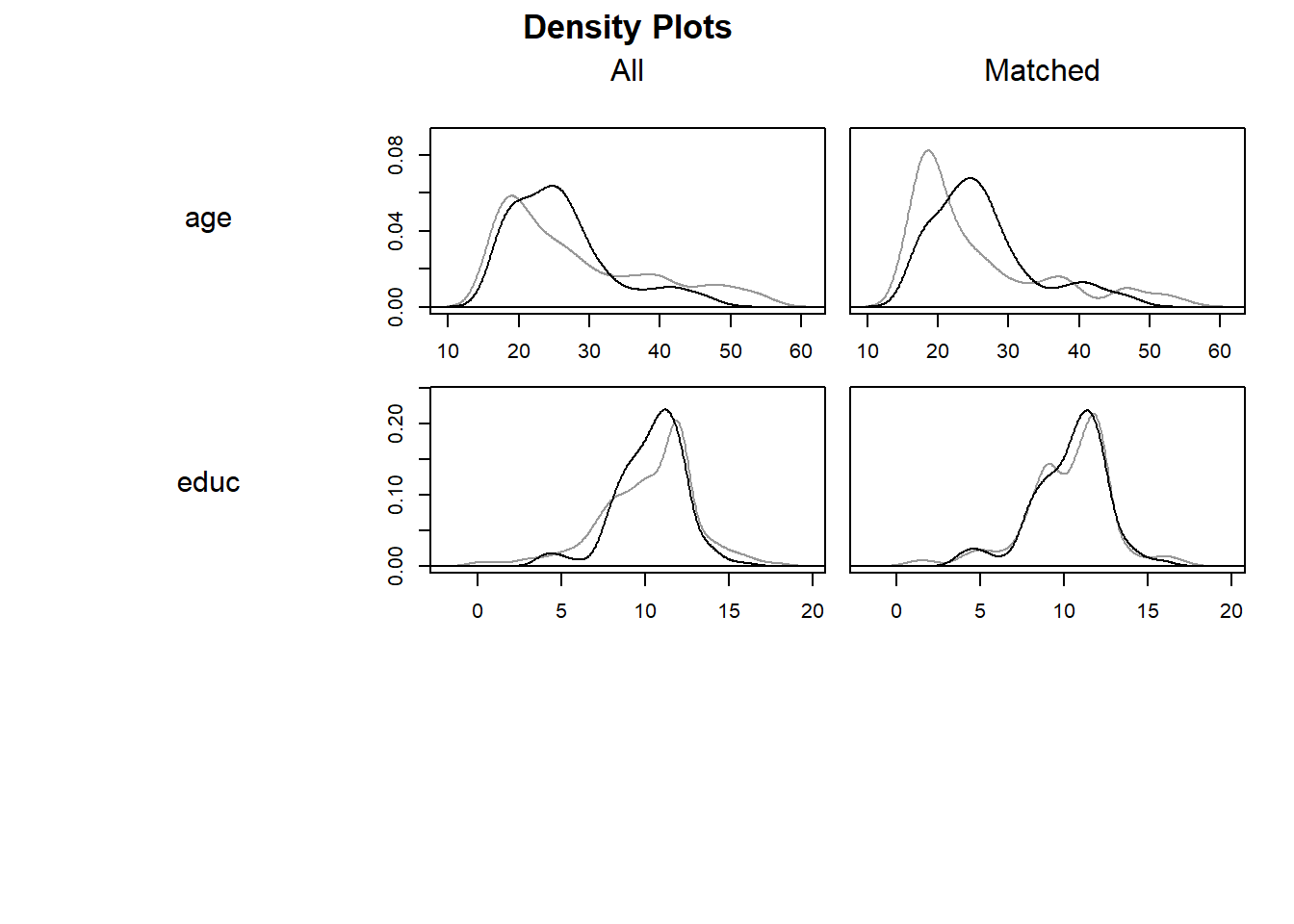
Covariate matching methods directly match units based on the similarity of their observed characteristics, rather than reducing them to a single propensity score. These methods preserve the multivariate structure of covariates and can achieve better balance.
Advantages Over Propensity Score Matching (PSM)
No information loss: Matching on full covariate space preserves all information
Better balance: Can achieve exact or near-exact balance on all covariates
Transparency: Easier to inspect and understand matches
Robustness: Not sensitive to propensity score model specification (e.g., non-parametric)
Mahalanobis Distance Matching
The Mahalanobis distance between units \(i\) and \(j\) is:
# Check imbalanceimbalance(group = df$treat, data = df, drop ="re78")
Multivariate Imbalance Measure: L1=1.000
Percentage of local common support: LCS=0.0%

Univariate Imbalance Measures:

             statistic   type        L1 min 25%       50%       75%     max
treat        1.0000000 (diff) 1.0000000   1   1     1.000     1.000    1.00
age         -2.2140868 (diff) 0.0000000   1   1     0.000    -6.000   -7.00
educ         0.1105147 (diff) 0.2170730   4   0     0.000     0.000   -2.00
race       224.0708295 (Chi2) 0.6404460  NA  NA        NA        NA      NA
married     -0.3236313 (diff) 0.3236313   0   0    -1.000    -1.000    0.00
nodegree     0.1113715 (diff) 0.1113715   0   0     0.000     0.000    0.00
re74     -3523.6628177 (diff) 0.0000000   0   0 -2547.047 -7985.660 9177.75
re75      -934.4291293 (diff) 0.0000000   0   0 -1086.726 -2064.135 6795.01
# Estimate treatment effect with weightsfit <-lm(re78 ~ treat + age + educ + race + nodegree + married + re74 + re75, data = df, weights = mat$w)summary(fit)
Call:
lm(formula = re78 ~ treat + age + educ + race + nodegree + married +
    re74 + re75, data = df, weights = mat$w)

Weighted Residuals:
   Min     1Q Median     3Q    Max
-13127      0      0      0  27730

Coefficients:
              Estimate Std. Error t value Pr(>|t|)
(Intercept) -1803.7914  6692.1386  -0.270   0.7879
treat         744.2106   972.4550   0.765   0.4454
age            31.9503    97.7658   0.327   0.7443
educ          505.1141   439.6080   1.149   0.2526
racehispan   4572.7844  2215.6024   2.064   0.0409 *
racewhite    2300.2659  1941.7918   1.185   0.2382
nodegree      281.2088  1887.4331   0.149   0.8818
married     -4922.4051  2541.8938  -1.937   0.0549 .
re74            0.3736     0.5127   0.729   0.4675
re75            1.3726     0.6705   2.047   0.0426 *
---
Signif. codes:  0 '***' 0.001 '**' 0.01 '*' 0.05 '.' 0.1 ' ' 1

Residual standard error: 5829 on 136 degrees of freedom
Multiple R-squared:  0.1188,    Adjusted R-squared:  0.06044
F-statistic: 2.036 on 9 and 136 DF,  p-value: 0.03975
# CEM not natively available in Python# Use rpy2 to call R's cem packageimport rpy2.robjects as rofrom rpy2.robjects import pandas2ripandas2ri.activate()ro.r('library(cem, quietly = TRUE)')# Convert pandas df to R dfr_data = pandas2ri.py2rpy(data)# Run CEM in Rresult = ro.r.cem('treat', data=r_data, drop='re78')weights = ro.r('result$w')
* Install cem* ssc install cemcem age educ black hispanic married nodegree re74 re75, treatment(treat)* Check balanceimbalance age educ black hispanic married nodegree re74 re75, by(treat)* Regression with CEM weightsreg re78 treat age educ black hispanic married nodegree re74 re75 [iw = cem_weights]
Genetic Matching
Concept
Genetic matching optimizes the weight matrix\(W\) in a generalized Mahalanobis distance to maximize covariate balance:
library(Matching, quietly =TRUE)# Datadata(lalonde) # same as df aboveattach(lalonde)# The covariates we want to match onX =cbind(age, educ, black, hisp, married, nodegr, u74, u75, re75, re74)# The covariates we want to obtain balance onBalanceMat <-cbind(age, educ, black, hisp, married, nodegr, u74, u75, re75, re74, I(re74*re75))# Genetic matching to find optimal weightsgenout <-GenMatch(Tr=treat, X=X, BalanceMatrix=BalanceMat, estimand="ATE", M=1,pop.size=16, max.generations=10, wait.generations=1, print.level =0)
Loading required namespace: rgenoud
# Match using optimized weightsmout <-Match(Y = re78,Tr = treat,X = X,estimand ="ATE",Weight.matrix = genout)# ATE Resultssummary(mout)
Estimate...  2079
AI SE......  810.25
T-stat.....  2.5659
p.val......  0.010291

Original number of observations..............  445
Original number of treated obs...............  185
Matched number of observations...............  445
Matched number of observations  (unweighted).  597
# Assess balancemb <-MatchBalance( treat ~ age + educ + black + hisp + married + nodegr + u74 + u75 + re75 + re74,match.out = mout,nboots =500)
***** (V1) age *****
                       Before Matching       After Matching
mean treatment........     25.816            25.119
mean control..........     25.054            24.994
std mean diff.........     10.655            1.8544

mean raw eQQ diff.....    0.94054           0.35511
med  raw eQQ diff.....          1                 0
max  raw eQQ diff.....          7                 8

mean eCDF diff........   0.025364         0.0097054
med  eCDF diff........   0.022193         0.0083752
max  eCDF diff........   0.065177          0.025126

var ratio (Tr/Co).....     1.0278           0.96842
T-test p-value........    0.26594           0.52651
KS Bootstrap p-value..      0.512             0.906
KS Naive p-value......     0.7481           0.99172
KS Statistic..........   0.065177          0.025126


***** (V2) educ *****
                       Before Matching       After Matching
mean treatment........     10.346              10.2
mean control..........     10.088            10.225
std mean diff.........     12.806           -1.4276

mean raw eQQ diff.....    0.40541           0.10553
med  raw eQQ diff.....          0                 0
max  raw eQQ diff.....          2                 2

mean eCDF diff........   0.028698         0.0075377
med  eCDF diff........   0.012682         0.0033501
max  eCDF diff........    0.12651          0.025126

var ratio (Tr/Co).....     1.5513            1.0569
T-test p-value........    0.15017           0.49442
KS Bootstrap p-value..      0.014             0.712
KS Naive p-value......   0.062873           0.99172
KS Statistic..........    0.12651          0.025126


***** (V3) black *****
                       Before Matching       After Matching
mean treatment........    0.84324            0.8382
mean control..........    0.82692           0.84045
std mean diff.........     4.4767          -0.60952

mean raw eQQ diff.....   0.016216          0.001675
med  raw eQQ diff.....          0                 0
max  raw eQQ diff.....          1                 1

mean eCDF diff........  0.0081601        0.00083752
med  eCDF diff........  0.0081601        0.00083752
max  eCDF diff........    0.01632          0.001675

var ratio (Tr/Co).....    0.92503            1.0114
T-test p-value........    0.64736           0.65487


***** (V4) hisp *****
                       Before Matching       After Matching
mean treatment........   0.059459           0.08764
mean control..........    0.10769           0.08764
std mean diff.........    -20.341                 0

mean raw eQQ diff.....   0.048649                 0
med  raw eQQ diff.....          0                 0
max  raw eQQ diff.....          1                 0

mean eCDF diff........   0.024116                 0
med  eCDF diff........   0.024116                 0
max  eCDF diff........   0.048233                 0

var ratio (Tr/Co).....    0.58288                 1
T-test p-value........   0.064043                 1


***** (V5) married *****
                       Before Matching       After Matching
mean treatment........    0.18919           0.16854
mean control..........    0.15385           0.16629
std mean diff.........     8.9995           0.59963

mean raw eQQ diff.....   0.037838          0.001675
med  raw eQQ diff.....          0                 0
max  raw eQQ diff.....          1                 1

mean eCDF diff........   0.017672        0.00083752
med  eCDF diff........   0.017672        0.00083752
max  eCDF diff........   0.035343          0.001675

var ratio (Tr/Co).....     1.1802            1.0108
T-test p-value........    0.33425           0.31731


***** (V6) nodegr *****
                       Before Matching       After Matching
mean treatment........    0.70811           0.78202
mean control..........    0.83462           0.78202
std mean diff.........    -27.751                 0

mean raw eQQ diff.....    0.12432                 0
med  raw eQQ diff.....          0                 0
max  raw eQQ diff.....          1                 0

mean eCDF diff........   0.063254                 0
med  eCDF diff........   0.063254                 0
max  eCDF diff........    0.12651                 0

var ratio (Tr/Co).....     1.4998                 1
T-test p-value........  0.0020368                 1


***** (V7) u74 *****
                       Before Matching       After Matching
mean treatment........    0.70811           0.73258
mean control..........       0.75           0.73034
std mean diff.........    -9.1895           0.50714

mean raw eQQ diff.....   0.037838          0.001675
med  raw eQQ diff.....          0                 0
max  raw eQQ diff.....          1                 1

mean eCDF diff........   0.020946        0.00083752
med  eCDF diff........   0.020946        0.00083752
max  eCDF diff........   0.041892          0.001675

var ratio (Tr/Co).....     1.1041           0.99472
T-test p-value........    0.33033           0.56385


***** (V8) u75 *****
                       Before Matching       After Matching
mean treatment........        0.6           0.64494
mean control..........    0.68462           0.64944
std mean diff.........    -17.225          -0.93815

mean raw eQQ diff.....   0.081081         0.0033501
med  raw eQQ diff.....          0                 0
max  raw eQQ diff.....          1                 1

mean eCDF diff........   0.042308          0.001675
med  eCDF diff........   0.042308          0.001675
max  eCDF diff........   0.084615         0.0033501

var ratio (Tr/Co).....     1.1133            1.0058
T-test p-value........   0.068031            0.4143


***** (V9) re75 *****
                       Before Matching       After Matching
mean treatment........     1532.1            1295.4
mean control..........     1266.9            1328.7
std mean diff.........     8.2363           -1.1277

mean raw eQQ diff.....     367.61            128.59
med  raw eQQ diff.....          0                 0
max  raw eQQ diff.....     2110.2            8195.6

mean eCDF diff........   0.050834         0.0082012
med  eCDF diff........   0.061954         0.0067002
max  eCDF diff........    0.10748          0.023451

var ratio (Tr/Co).....     1.0763            1.0046
T-test p-value........    0.38527           0.69008
KS Bootstrap p-value..      0.036             0.792
KS Naive p-value......    0.16449           0.99663
KS Statistic..........    0.10748          0.023451


***** (V10) re74 *****
                       Before Matching       After Matching
mean treatment........     2095.6              2002
mean control..........       2107            2053.7
std mean diff.........   -0.23437           -1.0605

mean raw eQQ diff.....     487.98            197.67
med  raw eQQ diff.....          0                 0
max  raw eQQ diff.....       8413            7870.3

mean eCDF diff........   0.019223         0.0061813
med  eCDF diff........     0.0158         0.0050251
max  eCDF diff........   0.047089          0.023451

var ratio (Tr/Co).....     0.7381            0.8693
T-test p-value........    0.98186           0.58258
KS Bootstrap p-value..      0.568             0.668
KS Naive p-value......    0.97023           0.99663
KS Statistic..........   0.047089          0.023451


Before Matching Minimum p.value: 0.0020368
Variable Name(s): nodegr  Number(s): 6

After Matching Minimum p.value: 0.31731
Variable Name(s): married  Number(s): 5
Entropy Balancing
Concept
Entropy balancing reweights control units to exactly match treatment group moments while minimizing information loss (maximum entropy).